
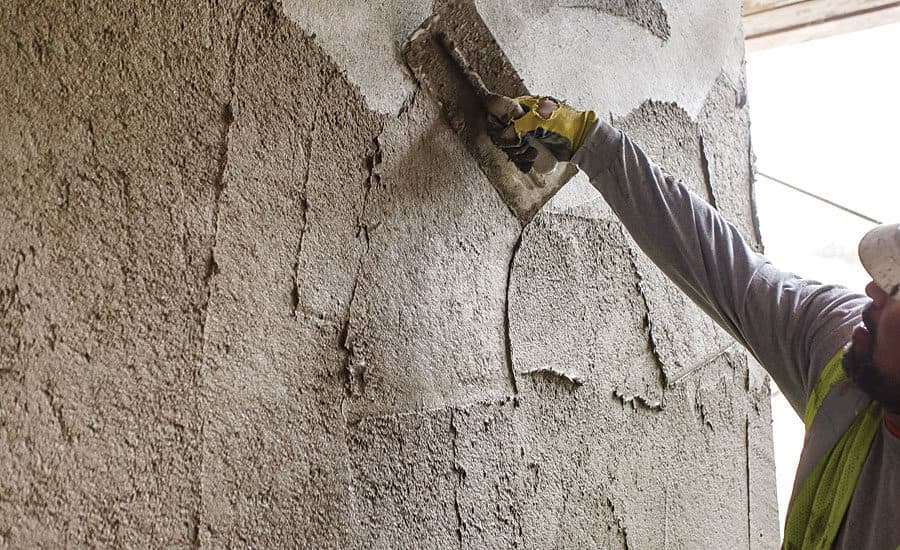
Lathing
Lath installation for stucco and adhered stone: weather barriers, self-furring lath, weep screeds, and control joints, fastened and inspected to spec.
01 / Lathing
What lathing is
Lathing is the skeleton of every stucco and adhered stone job: the weather barrier, metal lath, and trim accessories that everything else hangs on. Two layers of Grade D building paper or an equivalent water-resistive barrier go against the sheathing. Self-furring lath, expanded metal or woven wire, holds itself off the paper so plaster can key behind it. Casing beads, corner aid, control joints, and weep screeds complete the assembly. None of it is visible in the finished wall, and all of it decides whether the finished wall lasts.
02 / Lathing
How we lath
Paper laps shingle-style so water always runs onto the layer below, never behind it. Lath gets fastened into framing members at code spacing, not just into sheathing, with laps tied at the seams. Weep screed goes at the foundation line so the wall can drain, kept clear of grade and concrete. Control joints break large wall planes into panels that can move without cracking, placed by the layout rules, not wherever they are convenient. Inside and outside corners get reinforcement before any mud goes on. It is unglamorous work that determines everything above it.
03 / Lathing
When you need a lathing contractor
Every three-coat stucco and adhered stone veneer job starts with lath, so most of our lathing rides inside those scopes. Builders and GCs also hire us for lath-only packages: we hang paper and lath ready for another crew to plaster, or take over jobs where the lathing failed inspection. If your stucco is cracking in straight vertical lines, staining at the base of walls, or coming loose in sheets, the lath and paper behind it are the first suspects, and a repair that ignores them will not hold.
04 / Questions
Lathing FAQ.
What kind of lath do you use for stucco?
Self-furring expanded metal lath is the standard for most walls: the dimples hold it away from the paper so the scratch coat keys fully behind it. Woven wire and welded wire lath have their place on some assemblies, and paper-backed lath speeds up production walls. The right choice depends on the framing, the finish, and the inspection requirements on your job.
Why does stucco need two layers of building paper?
The scratch coat bonds to the outer layer of paper as it cures, which can wick moisture and degrade it over time. The second, inner layer stays intact as the true drainage plane. Codes call for a water-resistive barrier equal to two layers of Grade D paper over wood-based sheathing for exactly this reason.
What is a weep screed and why does it matter?
A weep screed is the perforated metal trim at the bottom of a stucco wall that lets moisture drain out of the assembly. Without it, water that gets behind the stucco sits at the foundation line and wicks upward, which is why older walls stain and spall at the base. It must stay above grade and clear of concrete or the wall cannot drain.
Need lathing done right?
We respond within one business day with a site walk, a sample, or a line-item estimate.